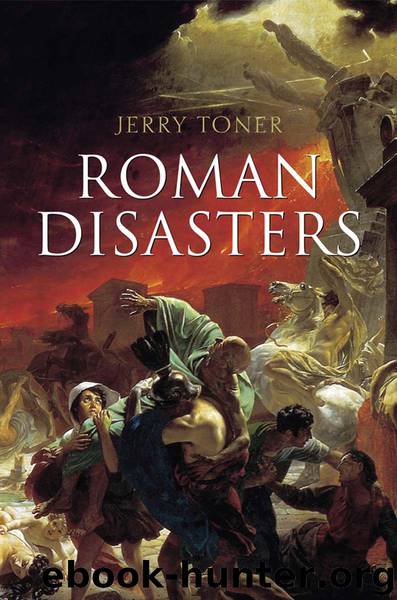
Roman Disasters by Jerry Toner
Author:Jerry Toner
Language: eng
Format: epub
Publisher: Wiley
Published: 2017-02-28T05:00:00+00:00
Disaster as Metaphor
Disaster could serve as a useful rhetorical tool in the Roman world because it often functioned as a metaphor for wider social issues. Disaster seemed to represent a microcosm of political, social and moral disorder. The uses to which disaster was put in the various texts means, as we have seen, that we can never take an ancient disaster account at face value. It is laden with some of the class differences I have discussed above, and served to promote a particular social, political or religious agenda. The representation of disaster, therefore, often distorted the reality of what had happened, or had a focus that was concordant with a particular point of view. Disaster could be seen as being caused by natural causes, demonic possession, supernatural punishment, or as merited by personal or collective transgression. Each of these explanations could be used to push a certain view of how society should be ordered.
Disaster represented disorder and the world turned upside down. We saw that Tacitus’ Histories starts with a list of the dreadful disasters that occurred during the period he is to cover in his work. It is a time of murdered emperors, wars both civil and foreign, revolts, volcanic eruption, and a great fire in Rome when ‘her most ancient shrines were consumed by the flames’. Sacred rites were defiled, adultery was rife in high places, cruelty abounded, and the aristocracy was persecuted by informers who benefited by being given priesthoods and consulships as rewards for their treachery, rewards which had been the traditional reserve of those of high birth. It was a time of upheaval when all the old social certainties were thrown up in the air, when ‘slaves were corrupted against their masters, freedmen against their patrons, and those who had no enemy were crushed by their friends’.26
But disaster could also act as a more specific metaphor. Ancient providentialism could easily turn a natural disaster into a divine response to political events.27For Christian authors the arrival of the pagan Julian as emperor in 361 CE, some half a century after the conversion of Constantine to Christianity, was nothing less than an unmitigated disaster. It threatened everything that had been achieved by the church in the fourth century. The Christian religion had been transformed from a relatively obscure, localized, urban sect into the most powerful religion within the empire. Later Christian writers, like Sozomen, therefore had an urgent need to condemn the reckless folly of Julian’s reign.28 Even though the reign proved to be short-lived, it was imperative that its disastrous consequences be spelled out for posterity lest any other emperor be tempted to apostasize, or lest Christians should neglect the task of stamping out the remains of paganism that persisted in many places. God, Sozomen argued, ‘gave manifest tokens of His displeasure, and permitted many calamities to befall several of the provinces of the Roman Empire’. God visited the earth with fearful earthquakes, tsunamis, a drought that was so oppressive that men were forced to eat the food usually eaten by animals, and a famine which introduced new and peculiar diseases.
Download
This site does not store any files on its server. We only index and link to content provided by other sites. Please contact the content providers to delete copyright contents if any and email us, we'll remove relevant links or contents immediately.
| Africa | Americas |
| Arctic & Antarctica | Asia |
| Australia & Oceania | Europe |
| Middle East | Russia |
| United States | World |
| Ancient Civilizations | Military |
| Historical Study & Educational Resources |
The Daily Stoic by Holiday Ryan & Hanselman Stephen(3322)
The Fate of Rome: Climate, Disease, and the End of an Empire (The Princeton History of the Ancient World) by Kyle Harper(3067)
People of the Earth: An Introduction to World Prehistory by Dr. Brian Fagan & Nadia Durrani(2738)
Ancient Worlds by Michael Scott(2688)
Babylon's Ark by Lawrence Anthony(2679)
The Daily Stoic by Ryan Holiday & Stephen Hanselman(2575)
Foreign Devils on the Silk Road: The Search for the Lost Treasures of Central Asia by Peter Hopkirk(2464)
India's Ancient Past by R.S. Sharma(2454)
MOSES THE EGYPTIAN by Jan Assmann(2417)
The Complete Dead Sea Scrolls in English (7th Edition) (Penguin Classics) by Geza Vermes(2283)
The Earth Chronicles Handbook by Zecharia Sitchin(2229)
Lost Technologies of Ancient Egypt by Christopher Dunn(2226)
24 Hours in Ancient Rome by Philip Matyszak(2084)
Alexander the Great by Philip Freeman(2065)
Aztec by Gary Jennings(2030)
The Nine Waves of Creation by Carl Johan Calleman(1917)
Curse Tablets and Binding Spells from the Ancient World by Gager John G.;(1862)
Before Atlantis by Frank Joseph(1854)
Earthmare: The Lost Book of Wars by Cergat(1825)
